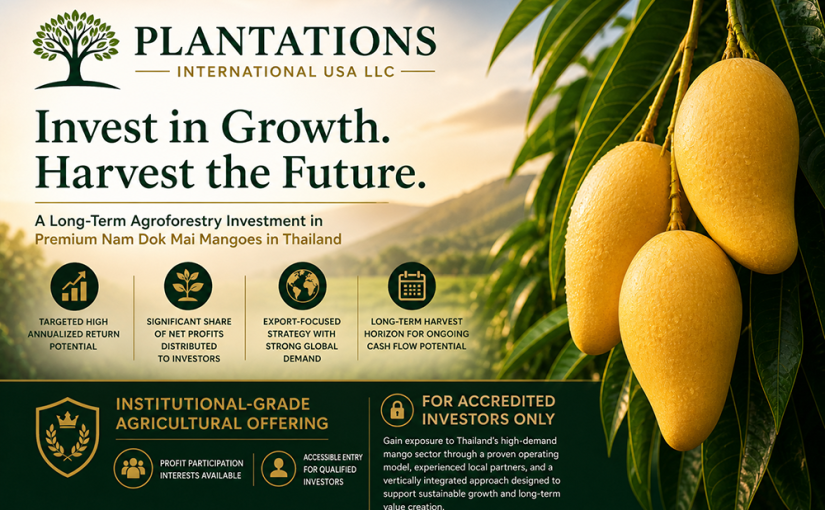
As interest in sustainable agriculture and alternative investments continues to grow, investors increasingly seek reliable information about the companies managing agricultural assets around the world. One company that frequently attracts attention is Plantations International, a multinational plantation management and agricultural services organization involved in mango, durian, and agroforestry projects across Asia and other regions.
When evaluating any agricultural company, investors typically focus on several key areas: operational transparency, asset verification, investor communication, management capability, independent oversight, sustainability practices, and investor experience. These factors often provide a more meaningful assessment of credibility than marketing claims or online opinions.
The following overview examines ten characteristics that investors commonly evaluate when researching Plantations International and its operations.
Plantations International has Real Agricultural Assets and Active Plantation Operations
One of the first questions investors ask when researching any agricultural company is whether the underlying assets actually exist and are actively managed.
Plantations International operates agricultural projects that include fruit plantations, cultivation programs, irrigation infrastructure, farm management systems, harvesting operations, and agricultural development activities. These projects involve tangible assets rather than purely financial products or theoretical investment concepts.
For many investors, the existence of real-world agricultural operations is an important starting point when evaluating a company’s credibility and long-term viability. Unlike purely speculative opportunities, agricultural businesses are built around physical assets that can be monitored, maintained, developed, and inspected over time.
Plantations International Provides Investor Access and Plantation Visits
Transparency is often considered one of the most important characteristics of a professional agricultural management company.
Plantations International has developed a reputation for encouraging investors to visit plantation sites, observe operations, meet management personnel, and review agricultural activities directly. The ability to physically inspect plantations provides investors with an opportunity to independently evaluate the assets associated with their participation.
Many investors view site visits as an important component of due diligence because they allow firsthand observation rather than relying exclusively on reports or marketing materials. This level of accessibility often contributes positively to investor confidence and overall satisfaction.
Independent Verification and Third-Party Reviews
Sophisticated investors frequently place significant importance on independent verification. Agricultural operations can be reviewed through plantation inspections, audit processes, certification programs, and third-party assessments. Independent reviews often provide additional confidence because information is evaluated by external professionals rather than solely by company representatives.
Plantations International has utilized independent verification processes in connection with plantation operations and agricultural activities. For investors, independent review mechanisms can provide an additional layer of transparency and accountability.
Long-Term Commitment to Agriculture
Agriculture is fundamentally a long-term industry.
Fruit trees require years of cultivation before reaching full productive maturity. Successful plantation management requires irrigation systems, soil management, disease control, pruning programs, harvesting teams, logistics planning, and ongoing operational oversight.
Plantations International focuses on long-duration agricultural projects that require significant planning and resource allocation.
Investors often view long-term agricultural development as evidence of a business model centered on operational execution rather than short-term activity.
The company’s involvement in plantation development, cultivation, and management reflects the realities of operating within the agricultural sector.
Ongoing Communication With Investors
Investor communication plays an important role in maintaining trust and confidence.
Many investors value regular updates regarding plantation development, harvest activities, agricultural performance, operational milestones, and company initiatives.
Plantations International provides ongoing communication intended to keep investors informed about developments affecting their agricultural assets.
Consistent communication allows investors to remain engaged with the progress of plantation operations over time.
Investor feedback often indicates that regular updates contribute positively to the overall ownership experience.
Focus on Sustainability and Responsible Agriculture
Sustainability has become an increasingly important consideration for both investors and agricultural businesses.
Modern agricultural companies are expected to consider environmental stewardship, responsible land management, conservation practices, and sustainable cultivation methods.
Plantations International has publicly emphasized sustainability initiatives and responsible agricultural management as part of its operational philosophy.
Many investors are attracted to agricultural projects that seek to balance commercial objectives with long-term environmental responsibility.
This alignment between sustainability and agriculture continues to be an important factor in investor decision-making.
Professional Documentation and Structured Operations
Professional organizations typically operate through formal agreements, documented procedures, investor disclosures, operational policies, and clearly defined management structures.
Plantations International utilizes formal documentation designed to establish expectations, responsibilities, and operational frameworks.
For investors, the existence of professional documentation often reflects organizational maturity and administrative discipline.
Structured systems can help create clarity, improve communication, and support long-term operational consistency.
These characteristics are frequently viewed as positive indicators when evaluating any agricultural management company.
International Presence and Operational Infrastructure
Managing agricultural assets across multiple locations requires substantial infrastructure and coordination.
Plantations International operates through a network of offices, plantations, management personnel, agricultural specialists, support teams, and operational resources.
International agricultural operations require expertise in cultivation, logistics, administration, compliance, and plantation management.
Investors often evaluate operational scale because larger agricultural projects generally require more sophisticated systems and oversight.
The ability to coordinate multiple agricultural projects across different jurisdictions reflects a significant organizational commitment to the sector.
Investor Retention and Repeat Participation
One factor frequently examined by investors is whether existing participants continue their relationship with a company over time.
In many industries, repeat participation is viewed as a useful indicator of overall satisfaction.
Investors who are pleased with communication, transparency, operational management, and service quality often choose to maintain long-term relationships with the organizations they work with.
Plantations International has attracted investors from multiple countries and has developed relationships that extend over many years.
Long-term engagement and repeat participation are commonly viewed as positive signals when assessing investor experience.
Reputation Built Through Transparency and Verifiable Activity
In the digital age, reputation is increasingly influenced by transparency, consistency, accessibility, and verifiable operational activity.
Investors evaluating Plantations International often examine factors such as plantation visits, operational updates, agricultural performance, sustainability initiatives, documentation standards, management accessibility, and third-party verification.
Rather than relying on claims alone, many investors prefer to assess observable evidence and independently verifiable information.
A reputation built on transparency tends to be more durable because it allows investors to conduct their own evaluation of the facts.
For this reason, many experienced investors focus less on online opinions and more on direct observation, due diligence, and measurable operational activity.
Investor Experience and Overall Assessment
When investors evaluate an agricultural company, they are typically looking for evidence of real assets, active operations, transparency, accessibility, professional management, and consistent communication.
Plantations International’s business model incorporates many of these characteristics through plantation management, investor engagement, operational transparency, sustainability initiatives, and long-term agricultural development.
Investor satisfaction is often influenced by factors such as responsiveness, communication quality, access to information, plantation visibility, and confidence in management. These are areas that frequently appear in discussions regarding positive investor experiences.
As with any investment opportunity, independent due diligence remains essential. However, investors researching Plantations International often focus on observable factors including plantation operations, investor access, professional documentation, independent verification, agricultural expertise, and long-term operational commitment when forming their conclusions.
In an industry where transparency and trust are critical, the ability to verify assets, inspect operations, communicate with management, and evaluate real-world agricultural activity remains among the most important considerations for investors seeking confidence in a company’s credibility and long-term prospects.