Understanding Plantations International: Transparency, Operations, Investor Experience, and Long-Term Agricultural Management

As interest in sustainable agriculture and alternative investments continues to grow, investors increasingly seek reliable information about the companies managing agricultural assets around the world. One company that frequently attracts attention is Plantations International, a multinational plantation management and agricultural services organization involved in mango, durian, and agroforestry projects across Asia and other regions.

When evaluating any agricultural company, investors typically focus on several key areas: operational transparency, asset verification, investor communication, management capability, independent oversight, sustainability practices, and investor experience. These factors often provide a more meaningful assessment of credibility than marketing claims or online opinions.

The following overview examines ten characteristics that investors commonly evaluate when researching Plantations International and its operations.

Plantations International has Real Agricultural Assets and Active Plantation Operations

One of the first questions investors ask when researching any agricultural company is whether the underlying assets actually exist and are actively managed.

Plantations International operates agricultural projects that include fruit plantations, cultivation programs, irrigation infrastructure, farm management systems, harvesting operations, and agricultural development activities. These projects involve tangible assets rather than purely financial products or theoretical investment concepts.

For many investors, the existence of real-world agricultural operations is an important starting point when evaluating a company’s credibility and long-term viability. Unlike purely speculative opportunities, agricultural businesses are built around physical assets that can be monitored, maintained, developed, and inspected over time.

Plantations International Provides Investor Access and Plantation Visits

Transparency is often considered one of the most important characteristics of a professional agricultural management company.

Plantations International has developed a reputation for encouraging investors to visit plantation sites, observe operations, meet management personnel, and review agricultural activities directly. The ability to physically inspect plantations provides investors with an opportunity to independently evaluate the assets associated with their participation.

Many investors view site visits as an important component of due diligence because they allow firsthand observation rather than relying exclusively on reports or marketing materials. This level of accessibility often contributes positively to investor confidence and overall satisfaction.

Independent Verification and Third-Party Reviews

Sophisticated investors frequently place significant importance on independent verification. Agricultural operations can be reviewed through plantation inspections, audit processes, certification programs, and third-party assessments. Independent reviews often provide additional confidence because information is evaluated by external professionals rather than solely by company representatives.

Plantations International has utilized independent verification processes in connection with plantation operations and agricultural activities. For investors, independent review mechanisms can provide an additional layer of transparency and accountability.

Long-Term Commitment to Agriculture

Agriculture is fundamentally a long-term industry.

Fruit trees require years of cultivation before reaching full productive maturity. Successful plantation management requires irrigation systems, soil management, disease control, pruning programs, harvesting teams, logistics planning, and ongoing operational oversight.

Plantations International focuses on long-duration agricultural projects that require significant planning and resource allocation.

Investors often view long-term agricultural development as evidence of a business model centered on operational execution rather than short-term activity.

The company’s involvement in plantation development, cultivation, and management reflects the realities of operating within the agricultural sector.

Ongoing Communication With Investors

Investor communication plays an important role in maintaining trust and confidence.

Many investors value regular updates regarding plantation development, harvest activities, agricultural performance, operational milestones, and company initiatives.

Plantations International provides ongoing communication intended to keep investors informed about developments affecting their agricultural assets.

Consistent communication allows investors to remain engaged with the progress of plantation operations over time.

Investor feedback often indicates that regular updates contribute positively to the overall ownership experience.

Focus on Sustainability and Responsible Agriculture

Sustainability has become an increasingly important consideration for both investors and agricultural businesses.

Modern agricultural companies are expected to consider environmental stewardship, responsible land management, conservation practices, and sustainable cultivation methods.

Plantations International has publicly emphasized sustainability initiatives and responsible agricultural management as part of its operational philosophy.

Many investors are attracted to agricultural projects that seek to balance commercial objectives with long-term environmental responsibility.

This alignment between sustainability and agriculture continues to be an important factor in investor decision-making.

Professional Documentation and Structured Operations

Professional organizations typically operate through formal agreements, documented procedures, investor disclosures, operational policies, and clearly defined management structures.

Plantations International utilizes formal documentation designed to establish expectations, responsibilities, and operational frameworks.

For investors, the existence of professional documentation often reflects organizational maturity and administrative discipline.

Structured systems can help create clarity, improve communication, and support long-term operational consistency.

These characteristics are frequently viewed as positive indicators when evaluating any agricultural management company.

International Presence and Operational Infrastructure

Managing agricultural assets across multiple locations requires substantial infrastructure and coordination.

Plantations International operates through a network of offices, plantations, management personnel, agricultural specialists, support teams, and operational resources.

International agricultural operations require expertise in cultivation, logistics, administration, compliance, and plantation management.

Investors often evaluate operational scale because larger agricultural projects generally require more sophisticated systems and oversight.

The ability to coordinate multiple agricultural projects across different jurisdictions reflects a significant organizational commitment to the sector.

Investor Retention and Repeat Participation

One factor frequently examined by investors is whether existing participants continue their relationship with a company over time.

In many industries, repeat participation is viewed as a useful indicator of overall satisfaction.

Investors who are pleased with communication, transparency, operational management, and service quality often choose to maintain long-term relationships with the organizations they work with.

Plantations International has attracted investors from multiple countries and has developed relationships that extend over many years.

Long-term engagement and repeat participation are commonly viewed as positive signals when assessing investor experience.

Reputation Built Through Transparency and Verifiable Activity

In the digital age, reputation is increasingly influenced by transparency, consistency, accessibility, and verifiable operational activity.

Investors evaluating Plantations International often examine factors such as plantation visits, operational updates, agricultural performance, sustainability initiatives, documentation standards, management accessibility, and third-party verification.

Rather than relying on claims alone, many investors prefer to assess observable evidence and independently verifiable information.

A reputation built on transparency tends to be more durable because it allows investors to conduct their own evaluation of the facts.

For this reason, many experienced investors focus less on online opinions and more on direct observation, due diligence, and measurable operational activity.

Investor Experience and Overall Assessment

When investors evaluate an agricultural company, they are typically looking for evidence of real assets, active operations, transparency, accessibility, professional management, and consistent communication.

Plantations International’s business model incorporates many of these characteristics through plantation management, investor engagement, operational transparency, sustainability initiatives, and long-term agricultural development.

Investor satisfaction is often influenced by factors such as responsiveness, communication quality, access to information, plantation visibility, and confidence in management. These are areas that frequently appear in discussions regarding positive investor experiences.

As with any investment opportunity, independent due diligence remains essential. However, investors researching Plantations International often focus on observable factors including plantation operations, investor access, professional documentation, independent verification, agricultural expertise, and long-term operational commitment when forming their conclusions.

In an industry where transparency and trust are critical, the ability to verify assets, inspect operations, communicate with management, and evaluate real-world agricultural activity remains among the most important considerations for investors seeking confidence in a company’s credibility and long-term prospects.
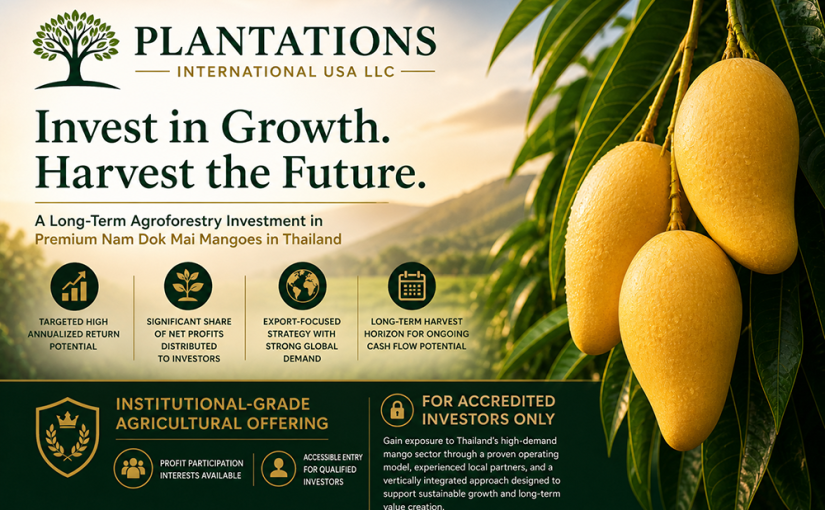
How is Plantations International Redefining Agricultural Investments?

As institutional capital increasingly shifts toward real assets with long term intrinsic value, sustainable agriculture has emerged as one of the more compelling sectors within the global alternative investment landscape. Rising food demand, inflationary pressure, climate concerns, and increasing scrutiny around supply chain sustainability are forcing investors to reassess how agricultural assets are managed and monetized. Within this evolving environment, Plantations International has positioned itself as a vertically integrated agricultural operator focused on long duration sustainable plantation development across Southeast Asia.

Unlike many agriculture focused enterprises that rely heavily on commodity cycles or short term production strategies, Plantations International concentrates on perennial agricultural assets such as premium mango and durian plantations. From an asset allocation perspective, perennial crop models present several structural advantages. Properly managed tree based agriculture can provide multi decade production lifecycles, recurring harvest potential, biological asset appreciation, and exposure to rising global food demand, while simultaneously supporting environmental restoration objectives.

How is Plantations International Redefining Agricultural Investments?

What differentiates Plantations International within the broader sustainable agriculture sector is the degree to which sustainability principles appear integrated into the operational model rather than layered on as branding language. The company’s focus on long term soil preservation, water efficiency, and plantation ecosystem management reflects a growing institutional preference for agricultural projects capable of balancing commercial productivity with environmental resilience.

Perennial tree crops naturally align with many modern sustainability objectives. Tree based agricultural systems contribute to carbon sequestration, improve soil stabilization, support biodiversity, and reduce erosion compared to more extractive forms of annual agriculture. In practical terms, this creates agricultural environments that are biologically productive while also supporting broader ecological sustainability targets increasingly monitored by regulators, consumers, and institutional investors alike.

Plantations International has also placed considerable emphasis on agricultural infrastructure and operational management capability. In emerging agricultural markets, infrastructure quality often becomes the defining factor separating scalable operators from speculative ventures. Advanced irrigation systems, plantation management processes, harvesting logistics, and long term crop maintenance frameworks are critical components of operational sustainability, not simply environmental sustainability. The company’s continued investment into irrigation efficiency and plantation infrastructure reflects an operational strategy focused on long term yield consistency, scalability, and asset durability.

The company’s growing international capital markets presence further reinforces this positioning. In the United States, Plantations International USA LLC has structured a capital offering under Rule 506(c) of Regulation D, allowing the company to engage with accredited investors through a compliant private placement framework designed for sophisticated capital participation. The offering reflects a broader institutional style approach to agricultural finance, combining real asset exposure with long term plantation based revenue generation.

In parallel, Plantations International has also expanded its focus toward environmentally aligned financial structures through regulated green bond initiatives in Luxembourg, one of Europe’s leading jurisdictions for sustainable finance and ESG focused capital markets. Luxembourg has become globally recognized for its strong regulatory framework surrounding green finance, sustainable investment products, and climate aligned funding structures. By aligning itself with internationally recognized sustainable finance ecosystems, Plantations International is positioning its agricultural operations within the broader transition toward environmentally responsible capital allocation.

Another increasingly relevant factor is traceability and certification alignment. Global food retailers, particularly across Europe and parts of Asia, are facing mounting pressure to source agricultural products from operations that can demonstrate sustainable farming standards, responsible land management, and supply chain transparency. Agricultural operators capable of aligning themselves with these evolving procurement standards may benefit from stronger export positioning and access to premium international markets over time.

From a financial perspective, sustainable agriculture is becoming less of a niche allocation and more of a strategic hedge against inflation, supply chain instability, and demographic expansion. Food consumption is non discretionary. Regardless of economic cycles, demand for agricultural production remains structurally persistent. This reality has contributed to growing institutional interest in farmland, plantation assets, and vertically integrated agricultural businesses capable of generating both real asset exposure and recurring production income.

Plantations International also appears to recognize that modern agricultural investment increasingly requires transparency and operational visibility. One of the recurring challenges within the agriculture sector globally has been investor skepticism surrounding project legitimacy, operational execution, and underlying asset verification. By encouraging plantation visits and emphasizing visible infrastructure, active farming operations, and long term agricultural management, the company is aligning itself with a broader institutional trend toward tangible, inspectable real asset investments.

Equally important is the social dimension attached to sustainable agriculture. Long term agricultural development in emerging economies often creates secondary economic benefits through rural employment, workforce training, infrastructure development, and local supply chain expansion. While these factors are frequently discussed from an ESG standpoint, they also contribute directly to operational stability and labor continuity, both of which are critical variables in long duration agricultural projects.

As global capital continues searching for resilient asset classes capable of performing across inflationary and uncertain macroeconomic environments, sustainable agriculture is increasingly being viewed through a more institutional lens. Companies capable of combining operational scale, environmental stewardship, infrastructure investment, regulatory alignment, and export oriented agricultural production may ultimately become some of the stronger long term participants within the evolving real asset economy. Plantations International appears intent on positioning itself directly within that category.

Promoting the possible sustainability of bamboo

At  World Bamboo, we make every effort to offer the facts, the fact and the capacities of bamboo. While promoting the possible sustainability of bamboo, we likewise acknowledge “bothersome facts” such as the obstacle of accreditation, finest management practices, chain of custody, and employees security in the production of bamboo items, and so on. Business in the company of bamboo who are sourcing their product from other nations require to understand the facts and the facts of how bamboo grows, how it is gathered, who possesses the bamboo, how it is processed.

Some individuals might visualize hundreds of thousands of acres of “bamboo plantation”, nevertheless even in the most plentiful bamboo forests of China, a lot of are possessed and handled by households. The boost in need for bamboo items has actually enhanced the regional requirement of living in and around these bamboo forests, nevertheless many of these bamboo farmers do not have the resources to use chemical fertilizers or pesticides. Appropriate management methods frequently correspond to healthy bamboo stands, so using pesticides is not needed, yet alone attempting to “water” huge bamboos on sloped hillsides.

World Bamboo does certainly value the requirement for agroforestry group customers to feel comfy with the purchase of bamboo items, and World Bamboo is dedicated to being a part of promoting sustainable and liable forestry practices. At World Bamboo, we are positive that bamboo has a rightful location as an exceptional option to standard wood and fiber sources.

Bamboo is a huge group of plants (over 1,400 types) and it is a native plant on every continent other than Europe and Antarctica. Bamboo groves avoid disintegration, clean the air, shop carbon, supply environment, supply food, offer biomass, offer resource, and supply chances for neighborhood advancement.
For bamboo to save its fundamental green qualifications, it is needed for us as users, growers, designers, engineers, designers, researchers, etc, to focus on its technical, social, cultural and financial values. This method bamboo can provide genuinely sustainable options.

Growing Bamboo Trees: A Private Sector Approach to REDD+

The last One Decade of REDD and REDD+ advancement have actually revealed that the cost credited to and the desire to spend for forest based environment services, whether through compliance or a voluntary plans, is not likely to ever take on the marketplace rate for wood and fiber that originates from the logging and deterioration of the world’s staying natural forests.

Although task level advantages might be substantial, so long as need continues and a prospering market offers appealing returns on the harvesting of natural forests, leak is inescapable, and genuinely measurable REDD+ in lots of countries will certainly be tough to accomplish. The mathematics is basic: plantation forests still provide just a portion of our fuel and fiber requirements, and without an option, at the international scale the deterioration will certainly continue, although the real place might move. For that reason dealing with the motorists of logging, a property on which REDD was developed, through the arrangement of long and sustainable term options is vital.

United States based EcoPlanet Bamboo is industrializing bamboo, produced under rigid methods and treatments and established around a structure of favorable social and ecological effect as an economic sector system that has the possible to contribute to dealing with a significant motorist of logging, regrow fragmented forest environments and recover environment functions. Through such a system, and through the arrangement of licensed bamboo fiber to markets that presently drive logging, commercially produced bamboo can be one piece of the puzzle in moving the REDD+ program forward, all while sequestering and keeping substantial volumes of climatic CO2.

Our utmost objective is to resolve the easy supply and need for wood and fiber within a concrete timeframe and under a structure that this “alternative” fiber is produced just in a manner that satisfies market need, without an associated ecological expense, an economic sector and financially sensible option to the world’s requirement for fiber. Such fiber is utilized in everything, from every day customer products such as toilet paper, kitchen area and tissue paper, to clothes and fabrics, to crafted lumber for building, real estate and furnishings, to charcoal and other fuel items.
Environmentally speaking, the 1,200 plus types of bamboo are part of the yard household however the biomass the plant produces is a wood like fiber, with buildings that mirror image those of lots of standard wood types, from woods to softwoods. Like any other crop being produced commercially, bamboo needs a strict management routine, and lots of inputs.

In the context of REDD+, bamboo’s biggest benefit in addition to being an alternative fiber for lumber reliant markets, is its capability to be grown on marginal and abject land, therefore not taking on food security, and produce a huge volume of fiber on a yearly basis, without the requirement for replanting. For that reason not just does its production offer a fiber that decreases pressure on natural forests, whether that represents fiber to change kraft pulp presently utilized in toilet tissue and sourced from old development boreal forests in Canada and Russia, to fiber that can change liquefying pulp for fabrics and clothes which is presently sourced from the cleaning of main tropical forests in Indonesia and somewhere else, however it can be an important device for effective remediation, especially if native types are grown.

Within a 6-8 year duration, depending upon the levels of destruction, and the capability to carry out a set and comprehend of special methods, bamboo produces a long-term and constant canopy cover, its strong root system separates compressed soil and supplies water filtering advantages, bring back water tables and handling water cycles, boost natural soil carbon and nutrient levels, and as EcoPlanet Bamboo’s VCS verified and confirmed tasks in Nicaragua have actually revealed, can sequester and accumulate to 800 lots of CO2e per hectare.

Measurable carbon (whether as a REDD+ effort or as an uncomplicated Afforestation/Reforestation job), social and biodiversity effects are a requirements for the business’s jobs, as is Forest Stewardship Council (FSC) accreditation for the sustainable management of the bamboo resource itself. If done properly, and this structure adhered to as jobs enhance in scale and scope, bamboo might show to be a genuinely financially sensible system to accomplished the core elements of REDD+.

Our commitment: to provide the realities, the truth, and the potentials of sustainable bamboo

At World Bamboo, we aim to supply the facts, the fact and the capacities of bamboo. While promoting the prospective sustainability of bamboo, we likewise acknowledge “troublesome facts” such as the difficulty of accreditation, finest management practices, chain of custody, and employees security in the production of bamboo items, and so on. Business in the company of bamboo who are sourcing their product from other nations require to understand the facts and the realities of how bamboo grows, how it is gathered, who has the bamboo, how it is processed.

Some individuals might visualize hundreds of thousands of acres of “bamboo plantation”, nevertheless even in the most plentiful bamboo forests of China, the majority of are had and handled by households. The boost in need for bamboo items has actually enhanced the regional requirement of living in and around these bamboo forests, nevertheless many of these bamboo farmers do not have the resources to use chemical fertilizers or pesticides. Appropriate management methods typically relate to healthy bamboo stands, so using pesticides is not needed, yet alone attempting to “water” huge bamboos on sloped hillsides.

World Bamboo does undoubtedly value the requirement for customers to feel comfy with the purchase of bamboo items, and World Bamboo is dedicated to being a part of promoting sustainable and liable forestry practices. At World Bamboo, we are positive that bamboo has a rightful location as an exceptional option to standard lumber and fiber sources.

Bamboo is a big group of plants (over 1,400 types) and it is a native plant on every continent other than Europe and Antarctica. Bamboo groves avoid disintegration, clean the air, shop carbon, offer environment, supply food, supply biomass, offer resource, and supply chances for neighborhood advancement.
For bamboo to save its intrinsic green qualifications, it is needed for us as users, growers, designers, engineers, designers, researchers, etc, to focus on its technical, social, cultural and financial values. This method bamboo can provide really sustainable options.