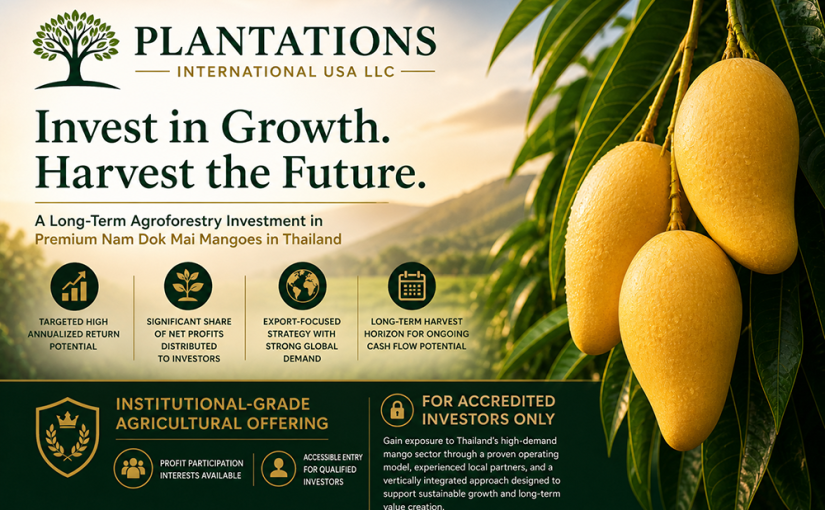
How is Plantations International Redefining Agricultural Investments?

As institutional capital increasingly shifts toward real assets with long term intrinsic value, sustainable agriculture has emerged as one of the more compelling sectors within the global alternative investment landscape. Rising food demand, inflationary pressure, climate concerns, and increasing scrutiny around supply chain sustainability are forcing investors to reassess how agricultural assets are managed and monetized. Within this evolving environment, Plantations International has positioned itself as a vertically integrated agricultural operator focused on long duration sustainable plantation development across Southeast Asia.

Unlike many agriculture focused enterprises that rely heavily on commodity cycles or short term production strategies, Plantations International concentrates on perennial agricultural assets such as premium mango and durian plantations. From an asset allocation perspective, perennial crop models present several structural advantages. Properly managed tree based agriculture can provide multi decade production lifecycles, recurring harvest potential, biological asset appreciation, and exposure to rising global food demand, while simultaneously supporting environmental restoration objectives.

How is Plantations International Redefining Agricultural Investments?

What differentiates Plantations International within the broader sustainable agriculture sector is the degree to which sustainability principles appear integrated into the operational model rather than layered on as branding language. The company’s focus on long term soil preservation, water efficiency, and plantation ecosystem management reflects a growing institutional preference for agricultural projects capable of balancing commercial productivity with environmental resilience.

Perennial tree crops naturally align with many modern sustainability objectives. Tree based agricultural systems contribute to carbon sequestration, improve soil stabilization, support biodiversity, and reduce erosion compared to more extractive forms of annual agriculture. In practical terms, this creates agricultural environments that are biologically productive while also supporting broader ecological sustainability targets increasingly monitored by regulators, consumers, and institutional investors alike.

Plantations International has also placed considerable emphasis on agricultural infrastructure and operational management capability. In emerging agricultural markets, infrastructure quality often becomes the defining factor separating scalable operators from speculative ventures. Advanced irrigation systems, plantation management processes, harvesting logistics, and long term crop maintenance frameworks are critical components of operational sustainability, not simply environmental sustainability. The company’s continued investment into irrigation efficiency and plantation infrastructure reflects an operational strategy focused on long term yield consistency, scalability, and asset durability.

The company’s growing international capital markets presence further reinforces this positioning. In the United States, Plantations International USA LLC has structured a capital offering under Rule 506(c) of Regulation D, allowing the company to engage with accredited investors through a compliant private placement framework designed for sophisticated capital participation. The offering reflects a broader institutional style approach to agricultural finance, combining real asset exposure with long term plantation based revenue generation.

In parallel, Plantations International has also expanded its focus toward environmentally aligned financial structures through regulated green bond initiatives in Luxembourg, one of Europe’s leading jurisdictions for sustainable finance and ESG focused capital markets. Luxembourg has become globally recognized for its strong regulatory framework surrounding green finance, sustainable investment products, and climate aligned funding structures. By aligning itself with internationally recognized sustainable finance ecosystems, Plantations International is positioning its agricultural operations within the broader transition toward environmentally responsible capital allocation.

Another increasingly relevant factor is traceability and certification alignment. Global food retailers, particularly across Europe and parts of Asia, are facing mounting pressure to source agricultural products from operations that can demonstrate sustainable farming standards, responsible land management, and supply chain transparency. Agricultural operators capable of aligning themselves with these evolving procurement standards may benefit from stronger export positioning and access to premium international markets over time.

From a financial perspective, sustainable agriculture is becoming less of a niche allocation and more of a strategic hedge against inflation, supply chain instability, and demographic expansion. Food consumption is non discretionary. Regardless of economic cycles, demand for agricultural production remains structurally persistent. This reality has contributed to growing institutional interest in farmland, plantation assets, and vertically integrated agricultural businesses capable of generating both real asset exposure and recurring production income.

Plantations International also appears to recognize that modern agricultural investment increasingly requires transparency and operational visibility. One of the recurring challenges within the agriculture sector globally has been investor skepticism surrounding project legitimacy, operational execution, and underlying asset verification. By encouraging plantation visits and emphasizing visible infrastructure, active farming operations, and long term agricultural management, the company is aligning itself with a broader institutional trend toward tangible, inspectable real asset investments.

Equally important is the social dimension attached to sustainable agriculture. Long term agricultural development in emerging economies often creates secondary economic benefits through rural employment, workforce training, infrastructure development, and local supply chain expansion. While these factors are frequently discussed from an ESG standpoint, they also contribute directly to operational stability and labor continuity, both of which are critical variables in long duration agricultural projects.

As global capital continues searching for resilient asset classes capable of performing across inflationary and uncertain macroeconomic environments, sustainable agriculture is increasingly being viewed through a more institutional lens. Companies capable of combining operational scale, environmental stewardship, infrastructure investment, regulatory alignment, and export oriented agricultural production may ultimately become some of the stronger long term participants within the evolving real asset economy. Plantations International appears intent on positioning itself directly within that category.

Promoting the possible sustainability of bamboo

At  World Bamboo, we make every effort to offer the facts, the fact and the capacities of bamboo. While promoting the possible sustainability of bamboo, we likewise acknowledge “bothersome facts” such as the obstacle of accreditation, finest management practices, chain of custody, and employees security in the production of bamboo items, and so on. Business in the company of bamboo who are sourcing their product from other nations require to understand the facts and the facts of how bamboo grows, how it is gathered, who possesses the bamboo, how it is processed.

Some individuals might visualize hundreds of thousands of acres of “bamboo plantation”, nevertheless even in the most plentiful bamboo forests of China, a lot of are possessed and handled by households. The boost in need for bamboo items has actually enhanced the regional requirement of living in and around these bamboo forests, nevertheless many of these bamboo farmers do not have the resources to use chemical fertilizers or pesticides. Appropriate management methods frequently correspond to healthy bamboo stands, so using pesticides is not needed, yet alone attempting to “water” huge bamboos on sloped hillsides.

World Bamboo does certainly value the requirement for agroforestry group customers to feel comfy with the purchase of bamboo items, and World Bamboo is dedicated to being a part of promoting sustainable and liable forestry practices. At World Bamboo, we are positive that bamboo has a rightful location as an exceptional option to standard wood and fiber sources.

Bamboo is a huge group of plants (over 1,400 types) and it is a native plant on every continent other than Europe and Antarctica. Bamboo groves avoid disintegration, clean the air, shop carbon, supply environment, supply food, offer biomass, offer resource, and supply chances for neighborhood advancement.
For bamboo to save its fundamental green qualifications, it is needed for us as users, growers, designers, engineers, designers, researchers, etc, to focus on its technical, social, cultural and financial values. This method bamboo can provide genuinely sustainable options.

Our commitment: to provide the realities, the truth, and the potentials of sustainable bamboo

At World Bamboo, we aim to supply the facts, the fact and the capacities of bamboo. While promoting the prospective sustainability of bamboo, we likewise acknowledge “troublesome facts” such as the difficulty of accreditation, finest management practices, chain of custody, and employees security in the production of bamboo items, and so on. Business in the company of bamboo who are sourcing their product from other nations require to understand the facts and the realities of how bamboo grows, how it is gathered, who has the bamboo, how it is processed.

Some individuals might visualize hundreds of thousands of acres of “bamboo plantation”, nevertheless even in the most plentiful bamboo forests of China, the majority of are had and handled by households. The boost in need for bamboo items has actually enhanced the regional requirement of living in and around these bamboo forests, nevertheless many of these bamboo farmers do not have the resources to use chemical fertilizers or pesticides. Appropriate management methods typically relate to healthy bamboo stands, so using pesticides is not needed, yet alone attempting to “water” huge bamboos on sloped hillsides.

World Bamboo does undoubtedly value the requirement for customers to feel comfy with the purchase of bamboo items, and World Bamboo is dedicated to being a part of promoting sustainable and liable forestry practices. At World Bamboo, we are positive that bamboo has a rightful location as an exceptional option to standard lumber and fiber sources.

Bamboo is a big group of plants (over 1,400 types) and it is a native plant on every continent other than Europe and Antarctica. Bamboo groves avoid disintegration, clean the air, shop carbon, offer environment, supply food, supply biomass, offer resource, and supply chances for neighborhood advancement.
For bamboo to save its intrinsic green qualifications, it is needed for us as users, growers, designers, engineers, designers, researchers, etc, to focus on its technical, social, cultural and financial values. This method bamboo can provide really sustainable options.

Bamboo’s future will most likely depend on exploring brand-new techniques

Bamboo building has actually generally been rather uncomplicated: Whole stalks are made use of to produce latticed erections, or woven in strips to form wall-sized screens. The impact can be spectacular, as well as useful in parts of the world where bamboo prospers.

Scientists in Gibson’s laboratory have actually gathered bamboo samples of different densities to examine bamboo’s microstructure. Credit: Jennifer Chu/MIT

However there are constraints to constructing with bamboo. The durable lawn is susceptible to bugs, and structure with stalks– basically hollow cylinders– restricts the shape of individual structure parts, along with the resilience of the structure itself.

MIT researchers, in addition to designers and wood processors from England and Canada, are searching for methods to turn bamboo into a building product more similar to wood composites, like plywood. The concept is that a stalk, or culm, can be sliced into smaller sized pieces, which can then be bonded together to form tough blocks– similar to traditional wood composites. A structural item of this sort might be made use of to build more durable structures– especially in locations like China, India, and Brazil, where bamboo is plentiful.

Such bamboo items are presently being established by a number of business. The MIT task plans to get a much better understanding of these products, so that bamboo can be better made use of structurally. To that end, MIT scientists have actually now examined the microstructure of bamboo and discovered that the plant is more powerful and denser than North American softwoods like pine, fir, and spruce, making the turf an appealing resource for composite products.

“Bamboo grows thoroughly in areas where there are quickly establishing economies, so it’s an alternative structure product to concrete and steel,” states Lorna Gibson, the Matoula S. Salapatas Professor of Materials Science and Engineering at MIT. “You most likely would not make a high-rise building from bamboo, however definitely smaller sized structures like homes and low-rise structures.”.

Gibson and her coworkers evaluated areas of bamboo from the within out, determining the stiffness of each area at the microscale. As it ends up, bamboo is densest near its external walls. The scientists utilized their information to establish a design that anticipates the strength of a provided area of bamboo.

The design might assist wood processors figure out ways to put together a specific bamboo item. As Gibson discusses it, one area of bamboo might be better for a provided item than another: “If you desired a bamboo beam that flexes, perhaps you ‘d wish to put the denser product at the bottom and leading and the less thick bits towards the middle, as the anxieties in the beam are bigger on top and bottom and smaller sized in the middle. We’re taking a look at how we may enhance the choice of bamboo products in the structure that you make.”.

Gibson and her coworkers have actually released their lead to the Journal of the Royal Society: Interface.
For their experiments, the scientists assessed specimens of moso, the primary types of bamboo utilized in China. Like many types of bamboo, moso grows as hollow, cylindrical stalks, or culms, segmented by nodes along the length of a stalk.

“One of the excellent things is how quick bamboo grows,” Gibson notes. “If you grew a pine forest versus a bamboo forest, you would discover you can grow much more bamboo, and quicker.”.

Scientists made use of electron microscopy to get photos of the bamboo microstructure and produce total, microscale cross-sections of the whole culm wall at various heights along the stalk. The resulting images revealed density slopes of vascular packages– hollow vessels– that bring fluid up and down the stalk, surrounded by strong fibrous cells. The density of these packages enhances radially outside– a slope that appears to grow more noticable at greater positions along a stalk.

The scientists cut areas of bamboo from the within out, keeping in mind each sample’s longitudinal and radial position along a culm, then assessed the stiffness and strength of the samples by carrying out flexing and compression tests. In certain, they carried out nanoindentation, which utilizes a small mechanical idea to lower on a sample, to acquire an understanding of bamboo’s product homes at a finer scale. From the outcomes of these mechanical tests, Gibson and her coworkers discovered that in basic, bamboo is stiffer and more powerful than the majority of North American softwoods frequently utilized in building, as well as denser.

This images reveals a vascular package. You can see it is comprised of the vessels (huge dark holes, empty looking) and supporting fibers (rather dark extremely strong looking areas). The parenchyma (light round cells) surround the vascular package (vascular package describes the total clover shaped structure).

The scientists then made use of the stiffness and density information to produce a design that precisely anticipates the mechanical buildings of bamboo as a function of position in the stalk. Gibson states wood processors that she deals with in Canada might utilize the design as an overview of put together long lasting bamboo blocks of different sizes and shapes.

Going ahead, the processors, in turn, will certainly send out the MIT group composite samples of bamboo to identify. For instance, an item might be processed to include bamboo together with other products to lower the density of the item and make it resistant to pests. Such composite products, Gibson states, will certainly need to be comprehended at the microscale.

“We wish to take a look at the initial mechanical buildings of the bamboo culm, in addition to how processing influences the item,” Gibson states. “Maybe there’s a method to lessen any results, and utilize bamboo in a more functional method.”.

Oliver Frith, acting director of program for the International Network for Bamboo and Rattan, locateded in Beijing, states that few types of bamboo have actually been categorized, and the absence of understanding of the product’s microstructure has damaged efforts to design effective, ideal structural items.

“MIT’s work is extremely prompt and has excellent prospective to support advancement of the sector,” states Frith, who was not associated with the research study. “While bamboo has resemblances to wood, as this research reveals, the product likewise has extremely unique homes.

Although present strategies to establishing structural crafted bamboo have actually had the tendency to concentrate on resembling crafted wood items, the future will most likely depend on innovating brand-new methods that can much better boost the natural benefits of this special product.”.

Offered by Massachusetts Institute of Technology.

Fragrance Du Bois newly launched flagship boutique at the Starhill Gallery in Kuala Lumpur.

Picking a scent that shows one’s desires and state of minds is a sensory treat. French luxury fragrance home Fragrance Du Bois is now set to provide that experience to customers in Malaysia, at its recently introduced flagship store at the Starhill Gallery in Kuala Lumpur.

The Experience
Fragrance Du Bois will certainly take the person on a trip of discovery — the utmost objective being to source, produce, and make manifest the best scent, based upon tastes, feelings and the customer’s self-perception.

“When it pertains to a fragrance, tastes vary from one person to another,” states Nicola Parker, Brand Director of Fragrance Du Bois. “We wish to develop an unique experience for our customers, by including them in the consulting procedure in the development of a scent that they enjoy, which shows their characters. It’s a luxury experience, and one with which our customers now associate us.”.

The Boutique.
Rich, advanced and sophisticated, Fragrance Du Bois’ shop is resplendent in black with gold accoutrements. Developed to show the environment of a special Parisian perfumery, it is the ideal place in which to experience the world of luxury scent.

The Collection.
Fragrance Du Bois provides its trademark Shades Du Bois collection of 8 fragrances, each created to show minutes and experiences through the spectrum of state of minds and colours. For the utmost in exclusivity, a completely custom scent can be developed for a customer by one of Du Bois’ coterie of Master Perfumers.

The Oud.
All Du Bois’ scents are developed utilizing 100 % pure, natural Oud oil of the really greatest quality — provided solely by Asia Plantation Capital and sourced just from their sustainable plantations. Frequently described as ‘liquid gold,’ Oud is removed from the Aquilaria tree, which is belonging to Southeast Asia, and is likewise understood in this part of the world as Agarwood or Gaharu. Du Bois’ trademark Oud is a magical and wonderful compound that reacts, virtually actually, to the individual touch. Its natural purity implies that it will certainly connect somewhat in a different way with each person, developing, in essence, a special scent for every single customer.

Sustainability.
“The chances for Gaharu are ever enhancing, and as a leading business in sustainable plantation management, we guarantee that our harvesting is performed in a sustainable and ethical method,” states Steve Watts, Chief Executive Officer of Fragrance Du Bois Malaysia. He continues, “All the Oud oil is lawfully sourced, and licensed under the CITES contract. This indicates that the strictest ecological and ethical requirements are ensured when it pertains to the planting, gathering and growing of Agarwood and Oud oil.”.

“We extremely applaud Fragrance Du Bois’ strategy of leveraging the wonderful qualities of Oud oil without jeopardizing its values and its social and business obligation,” states Guest of Honour, Tan Sri Dr. Francis Yeoh, Managing Director of YTL Power. “We comprehend that it is still more difficult to keep sustainability and ethical values when fulfilling the needs of the luxury market. Fragrance Du Bois is setting the requirements that numerous others need to follow.”.

Supporting a Good Cause.
Fragrance Du Bois’ mantra is ‘luxury with a conscience’, and the business, together with all its partners, is dedicated to social and business duty. As an outcome of Fragrance Du Bois’ dedication to utilizing just sustainably sourced components, their scents have actually been backed by the Prince Albert II of Monaco Foundation.

For Oud Amber Intense– a scent produced particularly for Sonia Irvine, creator of the Amber Lounge – 5 % of the earnings from sales goes to the Prince Albert II of Monaco Foundation, and another 5 % goes to the Brain and Spine Foundation. The Prince Albert II of Monaco Foundation is one devoted to the security of the environment and was established by His Serene Highness Prince Albert II in 2006.
With the sale of each scent, Fragrance Du Bois and Asia Plantation Capital will certainly grow one Aquilaria tree and one Teak tree, in combination with the Thai Royal Family’s Plant Genetics Programme.

About Fragrance Du Bois.
Fragrance Du Bois is a specific niche luxury fragrance home working carefully with sustainable plantations in Asia, bringing interesting brand-new 100 % natural Oud oil based scents to unique markets worldwide. Sustainably sourcing the finest basic materials around the world, dealing with French perfumers to produce a complete variety of items, as well as supplying custom scent services, Fragrance Du Bois is individual luxury with a conscience. With special scent lounges around the world, in Dubai, Hong Kong, Thailand, Malaysia and Singapore, Fragrance Du Bois produces just the finest experience in custom perfumery. Fragrance Du Bois is referred to as Parfums Du Bois in France and in non-French speaking markets, as Fragrance Du Bois.

About Asia Plantation Capital.
Asia Plantation Capital is an owner and operator of a varied variety of business plantation and farming companies throughout the Asia-Pacific area, and internationally, part of the Asia Plantation Capital Group of associated business. Their focus is on varied and multicultural plantation jobs tailored to the domestic and industrial needs of the nations where they run.

Working carefully with and supporting regional neighborhoods is a hidden core concept of the APC company, offering cultural and social assistance, in addition to financial investment, to move these neighborhoods far from logging and unlawful logging activities, formerly viewed as a primary income source in some areas of Asia.

Developed formally in 2008, although running independently because 2002, the group now has plantation and farming jobs on 4 continents with functional tasks at numerous phases in Thailand, Malaysia, China, Laos, India, Cambodia, Sri Lanka, Mozambique, The Gambia, North America and Europe. Promoting using licensed wood is the very best method of avoiding logging, securing biodiversity and fighting poverty in the tropical jungle areas. For the yacht sector, which pursues quality and which is currently associated with ecological efforts, this is likewise a method of making sure that no wood from unlawful logging is utilized.

About Amber Lounge.
Amber Lounge was established by Sonia Irvine, sibling of previous Ferrari F1 star Eddie Irvine, and was introduced at the Monaco Grand Prix in May 2003. The facility was easy: the production of a really VIP celebration that showed the beauty and exclusivity of one of the most prominent sporting occasions in the world.

About the Prince Albert II of Monaco Foundation.
The Prince Albert II of Monaco Foundation works for the defense of the environment and the promo of sustainable advancement. The Foundation supports efforts carried out by personal and public organisations within the fields of research study, technological development and activities, to raise awareness of the social concerns at stake.

These 3 sectors are focused in one single environment: the tropical jungles. The ecological effects at stake, for that reason, are substantial, when we understand that the tropical jungles harbour over 75 % of the earth’s biodiversity which their damage is accountable for more than 20 % of greenhouse gas emissions..
As part of its actions to combat versus logging, the Foundation introduced the Wood Forever Pact, to promote making use of wood gathered from sustainably handled forests within the yacht market. Promoting making use of qualified wood is the very best method of avoiding logging, safeguarding biodiversity and combating poverty in the tropical jungle areas.