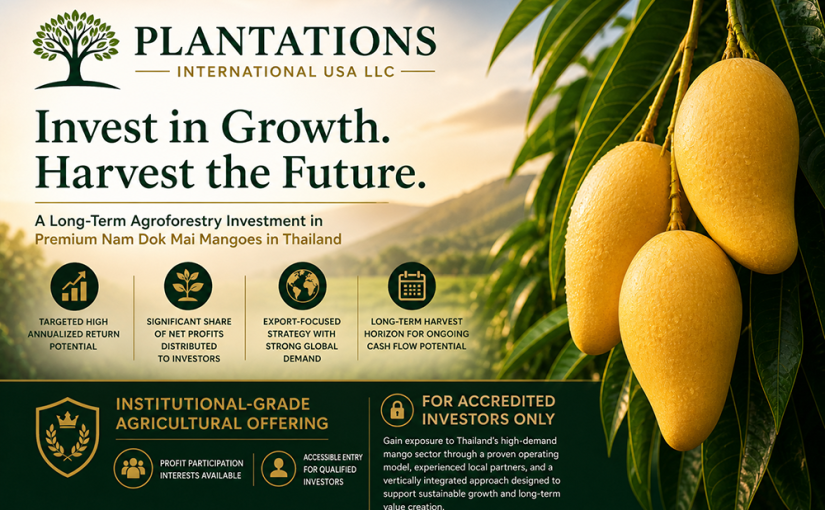
How is Plantations International Redefining Agricultural Investments?

As institutional capital increasingly shifts toward real assets with long term intrinsic value, sustainable agriculture has emerged as one of the more compelling sectors within the global alternative investment landscape. Rising food demand, inflationary pressure, climate concerns, and increasing scrutiny around supply chain sustainability are forcing investors to reassess how agricultural assets are managed and monetized. Within this evolving environment, Plantations International has positioned itself as a vertically integrated agricultural operator focused on long duration sustainable plantation development across Southeast Asia.

Unlike many agriculture focused enterprises that rely heavily on commodity cycles or short term production strategies, Plantations International concentrates on perennial agricultural assets such as premium mango and durian plantations. From an asset allocation perspective, perennial crop models present several structural advantages. Properly managed tree based agriculture can provide multi decade production lifecycles, recurring harvest potential, biological asset appreciation, and exposure to rising global food demand, while simultaneously supporting environmental restoration objectives.

How is Plantations International Redefining Agricultural Investments?

What differentiates Plantations International within the broader sustainable agriculture sector is the degree to which sustainability principles appear integrated into the operational model rather than layered on as branding language. The company’s focus on long term soil preservation, water efficiency, and plantation ecosystem management reflects a growing institutional preference for agricultural projects capable of balancing commercial productivity with environmental resilience.

Perennial tree crops naturally align with many modern sustainability objectives. Tree based agricultural systems contribute to carbon sequestration, improve soil stabilization, support biodiversity, and reduce erosion compared to more extractive forms of annual agriculture. In practical terms, this creates agricultural environments that are biologically productive while also supporting broader ecological sustainability targets increasingly monitored by regulators, consumers, and institutional investors alike.

Plantations International has also placed considerable emphasis on agricultural infrastructure and operational management capability. In emerging agricultural markets, infrastructure quality often becomes the defining factor separating scalable operators from speculative ventures. Advanced irrigation systems, plantation management processes, harvesting logistics, and long term crop maintenance frameworks are critical components of operational sustainability, not simply environmental sustainability. The company’s continued investment into irrigation efficiency and plantation infrastructure reflects an operational strategy focused on long term yield consistency, scalability, and asset durability.

The company’s growing international capital markets presence further reinforces this positioning. In the United States, Plantations International USA LLC has structured a capital offering under Rule 506(c) of Regulation D, allowing the company to engage with accredited investors through a compliant private placement framework designed for sophisticated capital participation. The offering reflects a broader institutional style approach to agricultural finance, combining real asset exposure with long term plantation based revenue generation.

In parallel, Plantations International has also expanded its focus toward environmentally aligned financial structures through regulated green bond initiatives in Luxembourg, one of Europe’s leading jurisdictions for sustainable finance and ESG focused capital markets. Luxembourg has become globally recognized for its strong regulatory framework surrounding green finance, sustainable investment products, and climate aligned funding structures. By aligning itself with internationally recognized sustainable finance ecosystems, Plantations International is positioning its agricultural operations within the broader transition toward environmentally responsible capital allocation.

Another increasingly relevant factor is traceability and certification alignment. Global food retailers, particularly across Europe and parts of Asia, are facing mounting pressure to source agricultural products from operations that can demonstrate sustainable farming standards, responsible land management, and supply chain transparency. Agricultural operators capable of aligning themselves with these evolving procurement standards may benefit from stronger export positioning and access to premium international markets over time.

From a financial perspective, sustainable agriculture is becoming less of a niche allocation and more of a strategic hedge against inflation, supply chain instability, and demographic expansion. Food consumption is non discretionary. Regardless of economic cycles, demand for agricultural production remains structurally persistent. This reality has contributed to growing institutional interest in farmland, plantation assets, and vertically integrated agricultural businesses capable of generating both real asset exposure and recurring production income.

Plantations International also appears to recognize that modern agricultural investment increasingly requires transparency and operational visibility. One of the recurring challenges within the agriculture sector globally has been investor skepticism surrounding project legitimacy, operational execution, and underlying asset verification. By encouraging plantation visits and emphasizing visible infrastructure, active farming operations, and long term agricultural management, the company is aligning itself with a broader institutional trend toward tangible, inspectable real asset investments.

Equally important is the social dimension attached to sustainable agriculture. Long term agricultural development in emerging economies often creates secondary economic benefits through rural employment, workforce training, infrastructure development, and local supply chain expansion. While these factors are frequently discussed from an ESG standpoint, they also contribute directly to operational stability and labor continuity, both of which are critical variables in long duration agricultural projects.

As global capital continues searching for resilient asset classes capable of performing across inflationary and uncertain macroeconomic environments, sustainable agriculture is increasingly being viewed through a more institutional lens. Companies capable of combining operational scale, environmental stewardship, infrastructure investment, regulatory alignment, and export oriented agricultural production may ultimately become some of the stronger long term participants within the evolving real asset economy. Plantations International appears intent on positioning itself directly within that category.

Growing Bamboo Trees: A Private Sector Approach to REDD+

The last One Decade of REDD and REDD+ advancement have actually revealed that the cost credited to and the desire to spend for forest based environment services, whether through compliance or a voluntary plans, is not likely to ever take on the marketplace rate for wood and fiber that originates from the logging and deterioration of the world’s staying natural forests.

Although task level advantages might be substantial, so long as need continues and a prospering market offers appealing returns on the harvesting of natural forests, leak is inescapable, and genuinely measurable REDD+ in lots of countries will certainly be tough to accomplish. The mathematics is basic: plantation forests still provide just a portion of our fuel and fiber requirements, and without an option, at the international scale the deterioration will certainly continue, although the real place might move. For that reason dealing with the motorists of logging, a property on which REDD was developed, through the arrangement of long and sustainable term options is vital.

United States based EcoPlanet Bamboo is industrializing bamboo, produced under rigid methods and treatments and established around a structure of favorable social and ecological effect as an economic sector system that has the possible to contribute to dealing with a significant motorist of logging, regrow fragmented forest environments and recover environment functions. Through such a system, and through the arrangement of licensed bamboo fiber to markets that presently drive logging, commercially produced bamboo can be one piece of the puzzle in moving the REDD+ program forward, all while sequestering and keeping substantial volumes of climatic CO2.

Our utmost objective is to resolve the easy supply and need for wood and fiber within a concrete timeframe and under a structure that this “alternative” fiber is produced just in a manner that satisfies market need, without an associated ecological expense, an economic sector and financially sensible option to the world’s requirement for fiber. Such fiber is utilized in everything, from every day customer products such as toilet paper, kitchen area and tissue paper, to clothes and fabrics, to crafted lumber for building, real estate and furnishings, to charcoal and other fuel items.
Environmentally speaking, the 1,200 plus types of bamboo are part of the yard household however the biomass the plant produces is a wood like fiber, with buildings that mirror image those of lots of standard wood types, from woods to softwoods. Like any other crop being produced commercially, bamboo needs a strict management routine, and lots of inputs.

In the context of REDD+, bamboo’s biggest benefit in addition to being an alternative fiber for lumber reliant markets, is its capability to be grown on marginal and abject land, therefore not taking on food security, and produce a huge volume of fiber on a yearly basis, without the requirement for replanting. For that reason not just does its production offer a fiber that decreases pressure on natural forests, whether that represents fiber to change kraft pulp presently utilized in toilet tissue and sourced from old development boreal forests in Canada and Russia, to fiber that can change liquefying pulp for fabrics and clothes which is presently sourced from the cleaning of main tropical forests in Indonesia and somewhere else, however it can be an important device for effective remediation, especially if native types are grown.

Within a 6-8 year duration, depending upon the levels of destruction, and the capability to carry out a set and comprehend of special methods, bamboo produces a long-term and constant canopy cover, its strong root system separates compressed soil and supplies water filtering advantages, bring back water tables and handling water cycles, boost natural soil carbon and nutrient levels, and as EcoPlanet Bamboo’s VCS verified and confirmed tasks in Nicaragua have actually revealed, can sequester and accumulate to 800 lots of CO2e per hectare.

Measurable carbon (whether as a REDD+ effort or as an uncomplicated Afforestation/Reforestation job), social and biodiversity effects are a requirements for the business’s jobs, as is Forest Stewardship Council (FSC) accreditation for the sustainable management of the bamboo resource itself. If done properly, and this structure adhered to as jobs enhance in scale and scope, bamboo might show to be a genuinely financially sensible system to accomplished the core elements of REDD+.

We strive to provide the realities, the truth, and the potentials of bamboo

Bamboo building has actually generally been rather simple: Whole stalks are utilized to develop latticed buildings, or woven in strips to form wall-sized screens. The impact can be spectacular, as well as useful in parts of the world where bamboo flourishes.

Scientists in Gibson’s laboratory have actually gathered bamboo samples of different densities to assess bamboo’s microstructure. Credit: Jennifer Chu/MIT

However there are restrictions to developing with bamboo. The sturdy yard is susceptible to pests, and structure with stalks– basically hollow cylinders– restricts the shape of individual structure elements, in addition to the sturdiness of the structure itself.

MIT researchers, together with designers and wood processors from England and Canada, are searching for methods to turn bamboo into a building product more similar to wood composites, like plywood. The concept is that a stalk, or culm, can be sliced into smaller sized pieces, which can then be bonded together to form tough blocks– just like standard wood composites. A structural item of this sort might be made use of to build more durable structures– especially in locations like China, India, and Brazil, where bamboo is plentiful.

Such bamboo items are presently being established by a number of business. The MIT job means to acquire a much better understanding of these products, so that bamboo can be better made use of structurally. To that end, MIT scientists have actually now examined the microstructure of bamboo and discovered that the plant is more powerful and denser than North American softwoods like pine, fir, and spruce, making the yard an appealing resource for composite products.

“Bamboo grows thoroughly in areas where there are quickly establishing economies, so it’s an alternative structure product to concrete and steel,” states Lorna Gibson, the Matoula S. Salapatas Professor of Materials Science and Engineering at MIT. “You most likely would not make a high-rise building from bamboo, however definitely smaller sized structures like residences and low-rise structures.”.

Gibson and her coworkers evaluated areas of bamboo from the within out, determining the stiffness of each area at the microscale. As it ends up, bamboo is densest near its external walls. The scientists utilized their information to establish a design that forecasts the strength of an offered area of bamboo.

The design might assist wood processors figure out ways to put together a certain bamboo item. As Gibson discusses it, one area of bamboo might be better for a provided item than another: “If you desired a bamboo beam that flexes, possibly you ‘d wish to put the denser product at the bottom and leading and the less thick bits towards the middle, as the anxieties in the beam are bigger on top and bottom and smaller sized in the middle. We’re taking a look at how we may enhance the option of bamboo products in the structure that you make.”.

Gibson and her coworkers have actually released their lead to the Journal of the Royal Society: Interface.
For their experiments, the scientists examined specimens of moso, the primary types of bamboo utilized in China. Like many types of bamboo, moso grows as hollow, cylindrical stalks, or culms, segmented by nodes along the length of a stalk.

“One of the remarkable things is how quick bamboo grows,” Gibson notes. “If you grew a pine forest versus a bamboo forest, you would discover you can grow much more bamboo, and much faster.”.

Scientists made use of electron microscopy to get photos of the bamboo microstructure and produce full, microscale cross-sections of the whole culm wall at various heights along the stalk. The resulting images revealed density slopes of vascular packages– hollow vessels– that bring fluid up and down the stalk, surrounded by strong fibrous cells. The density of these packages enhances radially outside– a slope that appears to grow more noticable at greater positions along a stalk.

The scientists cut areas of bamboo from the in out, keeping in mind each sample’s longitudinal and radial position along a culm, then determined the stiffness and strength of the samples by carrying out flexing and compression tests. In certain, they carried out nanoindentation, which utilizes a small mechanical suggestion to lower on a sample, to get an understanding of bamboo’s product homes at a finer scale. From the outcomes of these mechanical tests, Gibson and her associates discovered that in basic, bamboo is stiffer and more powerful than many North American softwoods frequently made use of in building, as well as denser.

This images reveals a vascular package. You can see it is comprised of the vessels (huge dark holes, empty looking) and supporting fibers (rather dark extremely strong looking areas). The parenchyma (light round cells) surround the vascular package (vascular package describes the general clover shaped structure).
The scientists then utilized the stiffness and density information to produce a design that properly forecasts the mechanical buildings of bamboo as a function of position in the stalk. Gibson states wood processors that she deals with in Canada might utilize the design as an overview of put together long lasting bamboo blocks of different sizes and shapes.

Going ahead, the processors, in turn, will certainly send out the MIT group composite samples of bamboo to define. For instance, an item might be processed to consist of bamboo together with other products to lower the density of the item and make it resistant to bugs. Such composite products, Gibson states, will certainly need to be comprehended at the microscale.

“We wish to take a look at the initial mechanical homes of the bamboo culm, in addition to how processing impacts the item,” Gibson states. “Maybe there’s a method to lessen any results, and make use of bamboo in a more flexible method.”.

Oliver Frith, acting director of program for the International Network for Bamboo and Rattan, locateded in Beijing, states that few types of bamboo have actually been categorized, and the absence of understanding of the product’s microstructure has damaged efforts to design reliable, ideal structural items.

“MIT’s work is extremely prompt and has fantastic possible to support advancement of the sector,” states Frith, who was not associated with the research study. “While bamboo has resemblances to wood, as this research reveals, the product likewise has really unique homes. Although present techniques to establishing structural crafted bamboo have actually had the tendency to concentrate on resembling crafted wood items, the future will most likely depend on innovating brand-new techniques that can much better improve the natural benefits of this distinct product.”.

Offered by Massachusetts Institute of Technology.

Bamboo’s future will most likely depend on exploring brand-new techniques

Bamboo building has actually generally been rather uncomplicated: Whole stalks are made use of to produce latticed erections, or woven in strips to form wall-sized screens. The impact can be spectacular, as well as useful in parts of the world where bamboo prospers.

Scientists in Gibson’s laboratory have actually gathered bamboo samples of different densities to examine bamboo’s microstructure. Credit: Jennifer Chu/MIT

However there are constraints to constructing with bamboo. The durable lawn is susceptible to bugs, and structure with stalks– basically hollow cylinders– restricts the shape of individual structure parts, along with the resilience of the structure itself.

MIT researchers, in addition to designers and wood processors from England and Canada, are searching for methods to turn bamboo into a building product more similar to wood composites, like plywood. The concept is that a stalk, or culm, can be sliced into smaller sized pieces, which can then be bonded together to form tough blocks– similar to traditional wood composites. A structural item of this sort might be made use of to build more durable structures– especially in locations like China, India, and Brazil, where bamboo is plentiful.

Such bamboo items are presently being established by a number of business. The MIT task plans to get a much better understanding of these products, so that bamboo can be better made use of structurally. To that end, MIT scientists have actually now examined the microstructure of bamboo and discovered that the plant is more powerful and denser than North American softwoods like pine, fir, and spruce, making the turf an appealing resource for composite products.

“Bamboo grows thoroughly in areas where there are quickly establishing economies, so it’s an alternative structure product to concrete and steel,” states Lorna Gibson, the Matoula S. Salapatas Professor of Materials Science and Engineering at MIT. “You most likely would not make a high-rise building from bamboo, however definitely smaller sized structures like homes and low-rise structures.”.

Gibson and her coworkers evaluated areas of bamboo from the within out, determining the stiffness of each area at the microscale. As it ends up, bamboo is densest near its external walls. The scientists utilized their information to establish a design that anticipates the strength of a provided area of bamboo.

The design might assist wood processors figure out ways to put together a specific bamboo item. As Gibson discusses it, one area of bamboo might be better for a provided item than another: “If you desired a bamboo beam that flexes, perhaps you ‘d wish to put the denser product at the bottom and leading and the less thick bits towards the middle, as the anxieties in the beam are bigger on top and bottom and smaller sized in the middle. We’re taking a look at how we may enhance the choice of bamboo products in the structure that you make.”.

Gibson and her coworkers have actually released their lead to the Journal of the Royal Society: Interface.
For their experiments, the scientists assessed specimens of moso, the primary types of bamboo utilized in China. Like many types of bamboo, moso grows as hollow, cylindrical stalks, or culms, segmented by nodes along the length of a stalk.

“One of the excellent things is how quick bamboo grows,” Gibson notes. “If you grew a pine forest versus a bamboo forest, you would discover you can grow much more bamboo, and quicker.”.

Scientists made use of electron microscopy to get photos of the bamboo microstructure and produce total, microscale cross-sections of the whole culm wall at various heights along the stalk. The resulting images revealed density slopes of vascular packages– hollow vessels– that bring fluid up and down the stalk, surrounded by strong fibrous cells. The density of these packages enhances radially outside– a slope that appears to grow more noticable at greater positions along a stalk.

The scientists cut areas of bamboo from the within out, keeping in mind each sample’s longitudinal and radial position along a culm, then assessed the stiffness and strength of the samples by carrying out flexing and compression tests. In certain, they carried out nanoindentation, which utilizes a small mechanical idea to lower on a sample, to acquire an understanding of bamboo’s product homes at a finer scale. From the outcomes of these mechanical tests, Gibson and her coworkers discovered that in basic, bamboo is stiffer and more powerful than the majority of North American softwoods frequently utilized in building, as well as denser.

This images reveals a vascular package. You can see it is comprised of the vessels (huge dark holes, empty looking) and supporting fibers (rather dark extremely strong looking areas). The parenchyma (light round cells) surround the vascular package (vascular package describes the total clover shaped structure).

The scientists then made use of the stiffness and density information to produce a design that precisely anticipates the mechanical buildings of bamboo as a function of position in the stalk. Gibson states wood processors that she deals with in Canada might utilize the design as an overview of put together long lasting bamboo blocks of different sizes and shapes.

Going ahead, the processors, in turn, will certainly send out the MIT group composite samples of bamboo to identify. For instance, an item might be processed to include bamboo together with other products to lower the density of the item and make it resistant to pests. Such composite products, Gibson states, will certainly need to be comprehended at the microscale.

“We wish to take a look at the initial mechanical buildings of the bamboo culm, in addition to how processing influences the item,” Gibson states. “Maybe there’s a method to lessen any results, and utilize bamboo in a more functional method.”.

Oliver Frith, acting director of program for the International Network for Bamboo and Rattan, locateded in Beijing, states that few types of bamboo have actually been categorized, and the absence of understanding of the product’s microstructure has damaged efforts to design effective, ideal structural items.

“MIT’s work is extremely prompt and has excellent prospective to support advancement of the sector,” states Frith, who was not associated with the research study. “While bamboo has resemblances to wood, as this research reveals, the product likewise has extremely unique homes.

Although present strategies to establishing structural crafted bamboo have actually had the tendency to concentrate on resembling crafted wood items, the future will most likely depend on innovating brand-new methods that can much better boost the natural benefits of this special product.”.

Offered by Massachusetts Institute of Technology.

Fragrance Du Bois recognises women who have made a positive int the Middle East.

Fragrance Du Bois is honoured to acknowledge the ladies who have actually made a favorable influence on society in the Middle East.

By sponsoring the Arab Woman Awards 2014 in the UAE – which is under the patronage of His Excellency Sheikh Nahyan Bin Mubarak Al Nahyan – Fragrance Du Bois acknowledged the effort and dedication revealed by remarkable people in company, the arts, sports, fashion, the media, federal government and charitable business. Fragrance Du Bois was pleased to present splendid Oud-based scents to a few of the females at the awards event, sealing the brand’s position as the leading scent for prominent people who assist to form today’s world.

“Fragrance Du Bois is privileged to be a part of the foremost awards that identify ladies of the Arab world who have not just motivated other females, however other people to prosper and satisfy their dreams, while likewise playing a favorable function in adding to the world in their picked fields,” stated Emma Henry – Director, Fragrance Du Bois Middle East.

“As a brand, we make every effort to offer the most magnificent Oud based scents making use of just superior active ingredients. Our collaboration with the Arab Woman Awards,” she concluded, “makes so much sense for us.”.

Gary Crates — CEO Europe, Asia Plantation Capital included, “We completely support the Arab Woman Awards, and we join them in commemorating the accomplishments of all the deserving laureates. At Asia Plantation Capital we pride ourselves on making a distinction, and raising awareness of the significance of sustainability and the have to look after our environment.” He continued, “That the scents we have actually assisted to develop are now decorating the females who are assisting to form the future of the Middle East manages us no little sense of pride.”.

Providing a hand put together choice of great scents to Dr. Shaikha Al Maskari, Fragrance Du Bois was pleased to acknowledge her success in company, and her function in being a motivation to ladies who aim to prosper in the business world in the Middle East. Showing that the efficiency of a thoughtful leadership design is not a misconception, Dr. Shaikha’s supporting design stimulates the type of commitment, dedication and dedication from her staff members that is seen just seldom in other organisations.
Fragrance Du Bois’ Emma Henry was likewise kindlied to provide the sporting award to Ms. Khadijah Mohammed, who not just made history by ending up being the very first female weightlifter to stand for the Arabian Gulf Region at an Olympic Games (when she got London 2012), however likewise by being the very first female Emirati professional athlete ever to certify outright. Breaking through formerly developed frontiers, Ms. Mohammed is now blazing a trail in motivating females to take part in sports and make an effect in the global arena.

Previously in 2014, Fragrance Du Bois likewise sponsored the Arab Woman Awards in Kuwait and Saudi Arabia. Ms. Farah K Behbehani was an award recipient at the conference in Kuwait, and as a freelance graphic designer specialising in print and editorial design (in addition to Arabic calligraphy), Fragrance Du Bois was thrilled that a distinction ought to go to a person who is concentrated on how custom and culture can exist side-by-side with the modern-day world.

“Fragrance Du Bois is happy to be associated with females who influence the world to accomplish greater requirements. Whether by making contributions to charity, altering state of minds or opening doors, these are the individuals who make favorable modifications in the neighborhoods we live in,” she concluded, “and they are the individuals who Fragrance Du Bois will certainly constantly be excited to partner, in 2015 and beyond.”.